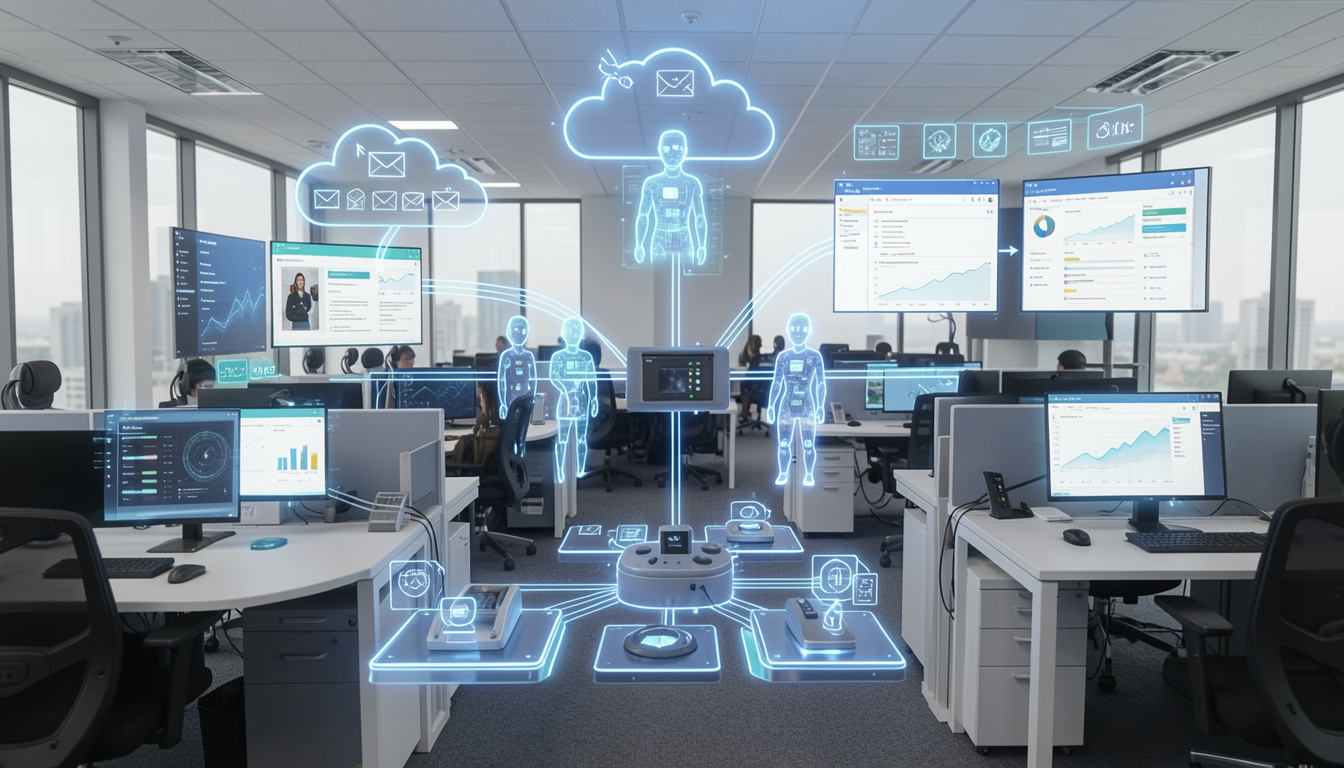
AI Agents Are Entering the Workplace: Is Your IT Ready?
As autonomous AI agents move into everyday business workflows, companies need secure infrastructure, access controls and proactive IT oversight before automation creates new risk.
AI agents are quickly becoming part of the modern workplace.
Unlike traditional AI tools that simply respond to prompts, AI agents can take action. They can connect to applications, retrieve information, complete tasks, trigger workflows and interact with business systems with limited human involvement.
For many companies, this creates a major opportunity. AI agents can help teams work faster, reduce repetitive tasks and improve operational efficiency.
But they also introduce a new challenge: most business IT environments were not designed for autonomous digital workers.
When an AI agent can access files, emails, cloud applications, customer records or internal systems, it becomes more than a tool. It becomes an active participant in the company’s technology environment.
That means it needs to be secured, monitored and governed like any other user, device or system.
For businesses working with IT Resources, preparing for AI agents is not about slowing innovation. It is about making sure automation is introduced safely, strategically and with the right controls in place.
What Makes AI Agents Different?
Most employees are already familiar with AI assistants that generate text, summarize documents or answer questions.
AI agents go a step further.
They are designed to complete multi-step tasks. For example, an AI agent might review a customer request, pull information from a CRM, draft a response, update a ticket and notify a team member.
That kind of workflow can be extremely useful.
But it also means the agent needs access to multiple systems. It may need permissions, credentials, API connections and data visibility.
This is where the risk begins.
A chatbot that answers questions is one thing. An AI agent that can act inside company systems is something else entirely.
Why Businesses Are Adopting AI Agents
Companies are adopting AI agents because they promise speed and scale.
They can help with:
- customer service workflows
- helpdesk triage
- document review
- scheduling
- reporting
- data entry
- compliance checks
- IT operations
- cybersecurity alerts
For small and mid-sized businesses, this can feel like a major advantage. Teams can automate work without hiring additional staff or building complex internal systems.
However, convenience should not come at the expense of security.
If AI agents are deployed without proper planning, they can create new blind spots across the organisation.
The Security Problem: AI Agents Need Access
Every AI agent needs some level of access to perform its work.
That access may include:
- reading files
- sending emails
- opening tickets
- updating databases
- connecting to cloud applications
- using APIs
- retrieving customer information
-
The problem is that many businesses do not have a clear process for managing AI agent permissions.
Who approves the agent’s access?
Who reviews what it can see?
Who monitors what it does?
Who removes access when the agent is no longer needed?
These questions matter because unmanaged access can expose sensitive data, increase compliance risk and create opportunities for attackers.
AI Agents Are Becoming a New Identity Challenge
In cybersecurity, identity has become one of the most important areas of protection.
For years, businesses focused mainly on human identities: employees, administrators, vendors and contractors.
Now, companies must also manage non-human identities.
These include service accounts, API keys, automation scripts and AI agents.
AI agents complicate identity management because they may act across systems, use delegated permissions and operate at machine speed.
This is why identity and access management is becoming central to AI security in 2026. Industry analysts have warned that AI agents are forcing businesses to rethink how they register, authorize and monitor digital actors inside enterprise systems.
For businesses, the key lesson is simple: if an AI agent can act, it needs an identity. And if it has an identity, it needs governance.
The Risk of Over-Permissioned AI Agents
One of the most common IT risks is excessive access.
Employees often accumulate permissions over time. AI agents can create the same problem, but faster.
An agent may only need access to one folder, but it gets access to an entire shared drive.
It may only need to read customer information, but it is also allowed to edit records.
It may only need to draft responses, but it is given permission to send messages automatically.
These small decisions can create serious exposure.
If an attacker manipulates an over-permissioned AI agent, the agent may be used to retrieve data, change workflows or trigger harmful actions.
That is why least-privilege access is essential.
AI agents should only receive the minimum permissions required to complete a specific task.
Prompt Injection and Manipulation Risks
AI agents also introduce a new type of security concern: prompt manipulation.
Because agents interpret instructions, attackers may try to influence them through carefully crafted inputs.
For example, a malicious message could instruct an agent to ignore previous rules, retrieve confidential information or perform an unauthorized action.
This is especially dangerous when AI agents are connected to email, customer service platforms, document repositories or ticketing systems.
Traditional security tools were not built to detect every form of prompt-based manipulation.
That is why AI agents need layered safeguards, including input filtering, restricted permissions, logging, human approval for high-risk actions and continuous monitoring.
Why Monitoring Is Non-Negotiable
An unmanaged AI agent can become invisible risk.
It may operate in the background, moving data between systems, taking actions and generating outputs without much oversight.
For IT teams, this creates a visibility problem.
Businesses need to know:
- which agents are active
- what systems they access
- what data they process
- what actions they perform
- whether their behavior changes over time
Monitoring is not about micromanaging automation. It is about maintaining control.
IT Resources helps clients build visibility across endpoints, cloud environments, applications and access patterns so AI-driven activity does not become another blind spot.
AI Agents and Business Continuity
AI agents can also affect business continuity.
If an agent is connected to critical workflows, a misconfiguration or failure could interrupt operations.
For example:
- a scheduling agent could send incorrect appointment confirmations
- a finance agent could route invoices incorrectly
- a support agent could close unresolved tickets
- an IT agent could trigger the wrong automation
- a reporting agent could produce inaccurate executive dashboards
These are not traditional outages, but they can still disrupt the business.
That is why AI agents should be included in continuity planning, incident response and change management.
What Businesses Should Audit Before Deploying AI Agents
Before deploying AI agents, businesses should complete a readiness review.
Key areas include:
- Data Access
What data will the agent need, and is that data sensitive? - Identity and Permissions
Does the agent have a unique identity and limited access? - Human Approval
Which actions require human review before execution? - Logging and Monitoring
Can the business track what the agent does? - Vendor Risk
Is the AI platform secure, compliant and properly reviewed? - Incident Response
What happens if the agent behaves incorrectly? - Lifecycle Management
Who reviews, updates or deactivates the agent?
This kind of planning helps businesses adopt AI without creating unnecessary exposure.
How IT Resources Helps Businesses Prepare
IT Resources helps clients prepare for AI agents by strengthening the foundation around them.
That includes:
- managed IT infrastructure
- secure cloud environments
- identity and access control
- endpoint protection
- network monitoring
- backup and recovery
- cybersecurity policies
- vendor risk review
- incident response planning
The goal is not just to deploy new tools. The goal is to make sure the business environment is ready to support them securely.
AI agents should not be added on top of weak systems, outdated permissions or unmonitored cloud applications.
They should be introduced into a managed, visible and secure IT ecosystem.
Why Small and Mid-Sized Businesses Should Pay Attention
AI agent security is not only an enterprise concern.
Small and mid-sized businesses are often more vulnerable because they adopt new tools quickly but may not have large internal IT teams to manage the risk.
An employee may connect an AI agent to company email.
A department may adopt an automation tool without IT approval.
A vendor may introduce AI features into an existing platform.
Before leadership realizes it, AI agents may already be operating inside the business environment.
This is where a managed IT partner becomes critical.
IT Resources gives businesses the technical oversight, monitoring and strategic guidance needed to adopt innovation without losing control.
Building an AI-Ready IT Environment
An AI-ready IT environment is built on four principles:
1. Visibility
Businesses need a clear view of users, devices, applications, data and automation.
2. Control
Access must be intentional, limited and reviewed.
3. Security
AI agents must be protected from misuse, manipulation and unauthorized access.
4. Accountability
Every automated action should be traceable to a system, owner and policy.
When these principles are in place, AI agents can become a productivity advantage instead of a security concern.
AI agents are entering the workplace quickly.
They will help companies automate work, improve response times and reduce manual effort. But they will also challenge traditional assumptions about identity, access, monitoring and governance.
Businesses that treat AI agents casually may expose sensitive data, create compliance issues and introduce operational risk.
Businesses that prepare properly will gain the benefits of automation with far greater confidence.
With IT Resources as a strategic IT partner, companies can build the secure, monitored and well-governed infrastructure needed for the next generation of workplace automation.
AI agents may be new, but the principle remains the same: technology should support the business without putting it at risk.